Trees of the Norse
Trees have always been our silent companions here on earth. From the beginning of human history they have sheltered us, shaded us, and served as an almost constant companion to us. They have grown stoically alongside us, and in turn been seen as forms of power and protection, strength and perseverance throughout the ages.
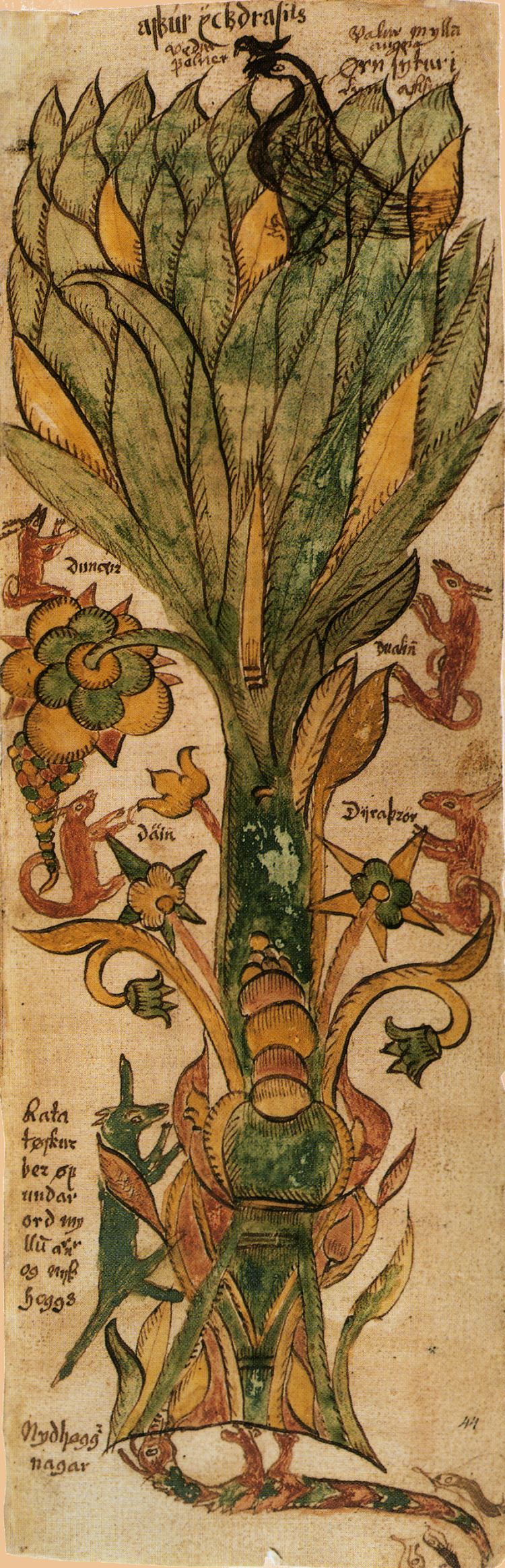 |
| Yggdrasil, from 17th century Icelandic manuscript, U.S. Public Doman |
This is definitely true for the Norse cultures, living in often barren environments, many of them heavily forested. The Ash Yggdrasil is the foundation of the Universe itself. Trees themselves were of immense value to the Norse and their survival, as well as their culture and religion. So I thought it might be interesting to share some Norse lore about different trees and there mythical and magical properties.
It seems wise to begin foremost with the Ash, perhaps the most sacred of all trees to the Norse. This is most evident in that Yggdrasil, the world tree is stated in several texts as being an ash specifically. Yggrasil is the structure of the Universe, its arms and roots serving as gateways of the Nine Worlds, its trunk serving as the very structure which hold all things in order.
There is some argument as to the exact meaning of the name Yggdrasil, but most scholars believe it literally means "Odin's horse." This seems a strange name for a tree, without some background. The Old Norse commonly called the gallows upon which men were hanged a "horse." Most believe that the name Yggdrasil refers explicitly to Odin's hanging when he took up the Runes, which would make the term "Odin's Horse" seem more plausible. The tree upon which Odin hung is never explicitly named. Regardless of this, we know that the ash was prized as Odin called it "the noblest of trees"in the Grimnismal.
The Ash is a tree of strength, protection, holiness, and initiation. There is much ash lore among the other European cultures who existed alongside the Norse as well. The traditional witch's besom possessed a handle of ash for its powers of strength and protection. Folklore suggests that the Druids saw the ash in a similar light to the Norse, as a tree which could protect and shelter humans. Celtic folklore suggests that the ash tree could be used to protect one from the fae folk as well.
Another important tree to the Norse was the Birch, so much so that one of the Runes, Berkana, was named for it. There has also been some argument that Yggdrasil may itself be a birch tree, rather than an ash. This is mainly due to some cultural examples from holy sites which possess centrally located sacred birch trees. One example of these is at a birch tree atop a burial mound which was shown to have evidence of ale having been regularly poured at its roots for centuries. Sadly that tree and many others have since been felled.
The Birch is associated with feminine goddesses such as Freyja, and was seen as symbolic of fecundity and fertility. It was a potent symbol of womanhood and the feminine mysteries. One interesting bit of folkloric tradition shows that young men would often sneak into their intendeds yards during the night and decorate a birch tree there to show his affection. This in itself illustrates the potent connections between the birch tree, women, and amorous activities of all kinds.
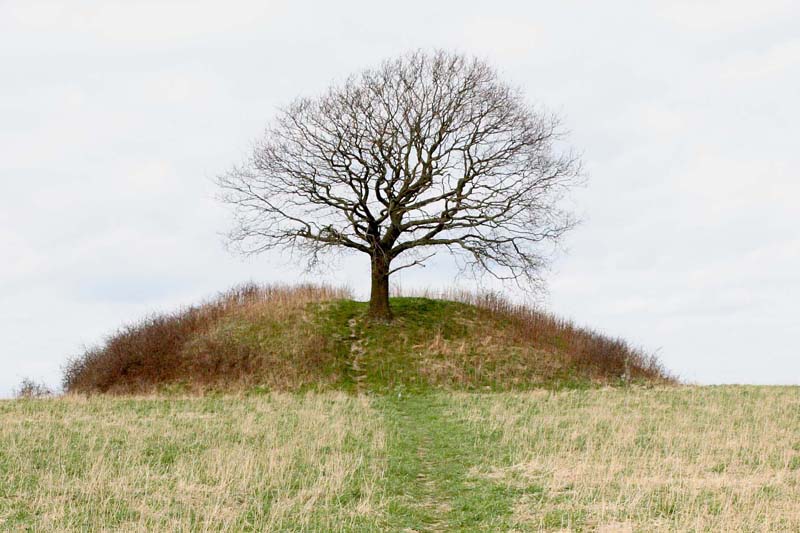 |
| Mysselhøj, a danish gravemound from the early bronze age situated close to the danish town Roskilde. Photo taken by Jørgen Larsen, 2007-04-07. |
I would like to revisit this topic and explore more, as I have found such a wealth of information about the Norse and tree folklore which deserves deeper exploration. I will leave you with a question...
What role do tress play in your own spirituality, and are you particular fond of one species? The oak and pecan are both special to me personally. I hope you all take the time to get to know these silent companions in your own lives.
In Frith
Cena
In Frith
Cena


I love trees! There's a maple tree in my yard who has always seemed very....protective. It's hard to explain. I also love willow trees.
ReplyDeleteI kind of wish more books on trees stepped away from the Celtic tree calendar and took a more Pan-Pagan approach, plenty of cultures had their special trees.
I understand totally there. I have a very special oak tree in my yard that I feel is more than just a tree if you catch my drift. I leave offerings for her all the time. I would love to see more on working with trees in a non celtic sense as well. Not enough info out there in general.
ReplyDeleteI'm curious about your thoughts about the yew tree. It seems to have been an important tree in the Norse and I've seen some convincing arguments that Yggdrasil is actually a yew tree.
ReplyDelete