The Marriage of Freyja: An Oddity of the Gods
Tonight I was reading a fairly dated (1982) academic essay called CONCENTRIC DUALISM AS TRANSITION BETWEEN A LINEAL AND CYCLIC REPRESENTATION
OF LIFE AND DEATH IN SCANDINAVIAN MYTHOLOGY by H. A. MOLENAAR which I found to be seriously lacking on several points, but I digress. The essay is concerned mostly with Scandinavian cycles of death and its opposition to life, and it explores various ideals of the underworld presented in the myths. What I found most interesting about the essay was its short discussion of marriage as an opposite force to that of death, ie marriage as "life-giving" versus death as well, death.The author explored several examples of marriages and proposed marriages within the myths, the majority of which, no surprise, centered on the Vanir gods.
There was some discussion in the paper of the inability of giants to secure goddesses as brides and bring them and their powers into their own world, yet it is common for male gods to bring giantess brides into the world of the gods. There are many examples of this, for example Frigga, Gerd, and Skadi were all giantesses brought into the realm of the gods as brides. I can think of no examples of a female goddess who was successfully married and taken into the realm of the giants. The example given to illustrate this inability is Freyja herself, who is betrothed to the un-named giant in Gylfaginning who requests her as his bride in exchange for building walls around Asgard that no giant will be able to cross. Though the gods agree this giant is ultimately outwitted by the gods and finds himself unable to fulfill his end of the bargain to secure her.
This inability struck me as strange when I realized it, scouring my mind to try and find any example of a female goddess of the Norse who was married to a male giant, or even married outside of the "race" of the gods. None. None except Freyja.
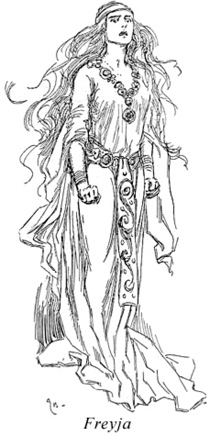
Isn't it interesting that so little is known about her mysterious husband Odr? Of course there are still some who believe that Odr is simply a veiled name for Odin himself, yet as I have discussed several time this conclusion has always been considered questionable on a number of levels. The lack of information on Odr makes it very hard to name him as one among the gods, and in the translations I have read (many) she is simply said to have married a MAN called Odr, which I have always taken to denote him as a non-divine, perhaps even mortal being. This is Freyja's only known marriage, though her affairs with men (Ottar), dwarves, and perhaps others are often central to the myths which surround her. She is called promiscuous by Loki himself!
It struck me that there has to be some meaning behind this anomaly within the myths. I haven't personally figured it out yet for myself. But I think it is an avenue of study that needs to be explored. There is something quite exceptional in the fact that Freyja seems to be the only goddess among the Aesir and Vanir who married outside of the realm of the gods, and took her powers with her on some level. There is something about Freyja that sets her apart from the other female divinities and allows her to possess and wield her power outside of the accepted boundaries.
In the marriages of the male gods of the Norse, one often sees a reflection of the accepted conventions and roles surrounding marriage in Norse society. The patriarchal power structures, the movement of wealth, lands, and power into the control of the masculine grooms, the giving of life and sovereignty by feminine sacredness. Yet in marriage Freyja shows yet another example of a feminine principle that remains forever in control of her own fate and her own power. What is her secret?
Is it her connection to fertility and sexuality, the necessity on some level that such power flows more freely within the realms in order to perpetuate the cycles of life and death? Is it her connection to seidr and in turn the volva, the enigmatic seeresses and sorceresses that moved outside the bounds of the inner courtyard yet were accepted because of the importance of the services they gave to society? One cannot help but see the similarities between the life of the traveling volvas in saga and the "many-named" goddess who travel among many "strange folk" in search of her lost husband. I suppose more thought and study will be necessary for me to draw any conclusions.
And as always this Freyja's woman is both perplexed and awed at the myriad ways that Freyja presents a womanhood so very different from that of any other among her gender.
In Frith
Cena
OF LIFE AND DEATH IN SCANDINAVIAN MYTHOLOGY by H. A. MOLENAAR which I found to be seriously lacking on several points, but I digress. The essay is concerned mostly with Scandinavian cycles of death and its opposition to life, and it explores various ideals of the underworld presented in the myths. What I found most interesting about the essay was its short discussion of marriage as an opposite force to that of death, ie marriage as "life-giving" versus death as well, death.The author explored several examples of marriages and proposed marriages within the myths, the majority of which, no surprise, centered on the Vanir gods.
There was some discussion in the paper of the inability of giants to secure goddesses as brides and bring them and their powers into their own world, yet it is common for male gods to bring giantess brides into the world of the gods. There are many examples of this, for example Frigga, Gerd, and Skadi were all giantesses brought into the realm of the gods as brides. I can think of no examples of a female goddess who was successfully married and taken into the realm of the giants. The example given to illustrate this inability is Freyja herself, who is betrothed to the un-named giant in Gylfaginning who requests her as his bride in exchange for building walls around Asgard that no giant will be able to cross. Though the gods agree this giant is ultimately outwitted by the gods and finds himself unable to fulfill his end of the bargain to secure her.
This inability struck me as strange when I realized it, scouring my mind to try and find any example of a female goddess of the Norse who was married to a male giant, or even married outside of the "race" of the gods. None. None except Freyja.
Isn't it interesting that so little is known about her mysterious husband Odr? Of course there are still some who believe that Odr is simply a veiled name for Odin himself, yet as I have discussed several time this conclusion has always been considered questionable on a number of levels. The lack of information on Odr makes it very hard to name him as one among the gods, and in the translations I have read (many) she is simply said to have married a MAN called Odr, which I have always taken to denote him as a non-divine, perhaps even mortal being. This is Freyja's only known marriage, though her affairs with men (Ottar), dwarves, and perhaps others are often central to the myths which surround her. She is called promiscuous by Loki himself!
It struck me that there has to be some meaning behind this anomaly within the myths. I haven't personally figured it out yet for myself. But I think it is an avenue of study that needs to be explored. There is something quite exceptional in the fact that Freyja seems to be the only goddess among the Aesir and Vanir who married outside of the realm of the gods, and took her powers with her on some level. There is something about Freyja that sets her apart from the other female divinities and allows her to possess and wield her power outside of the accepted boundaries.
In the marriages of the male gods of the Norse, one often sees a reflection of the accepted conventions and roles surrounding marriage in Norse society. The patriarchal power structures, the movement of wealth, lands, and power into the control of the masculine grooms, the giving of life and sovereignty by feminine sacredness. Yet in marriage Freyja shows yet another example of a feminine principle that remains forever in control of her own fate and her own power. What is her secret?
Is it her connection to fertility and sexuality, the necessity on some level that such power flows more freely within the realms in order to perpetuate the cycles of life and death? Is it her connection to seidr and in turn the volva, the enigmatic seeresses and sorceresses that moved outside the bounds of the inner courtyard yet were accepted because of the importance of the services they gave to society? One cannot help but see the similarities between the life of the traveling volvas in saga and the "many-named" goddess who travel among many "strange folk" in search of her lost husband. I suppose more thought and study will be necessary for me to draw any conclusions.
And as always this Freyja's woman is both perplexed and awed at the myriad ways that Freyja presents a womanhood so very different from that of any other among her gender.
In Frith
Cena


Comments
Post a Comment