The Winds of Seidr

This post is intended as an illustration of one instance in which my practice as an earth based elemental witch melded with my faith as a Vanatru. I practiced witchcraft before I was called by Freyja, and to this day I believe there was a reason for this. I am aware that the idea of elements has no basis in historical philosophies related to the Norse culture. All the same, I felt powerfully drawn to the Vanir and Freyja in particular. I studied her lore for a year before I decided that this was the path for me. Part of the reason for that is what I learned about her and the history of seidr and magical art in the Northern regions of Europe.
I should preface this discussion by explaining some of my beliefs about the elements. I use the system of four, earth, air, fire, and water. In my personal philosophy, the element of earth is primary, as every other element can be found within it. The most independent element (arguably) from the elemental earth I see as the element of wind. To me the element of wind represents change, consciousness, and what one might call spirit. More specifically I see wind as the container of all non-corporeal life and a vehicle for energy. Even the earth element cannot create life without wind, without air. We need only look at the moon and see the destructive power that comes from the elements when the power of air is removed. It's haggard surface is a testament to the energy held within the element of wind, or more surely the lack of it.
When I read the paper Spinning Seidr by Eldar Heide not long after I started learning about Freyja, much of what I felt she was trying to teach me about her arts came into clarity. Something about the spinning of cords and yarn so deftly described in relation to seidr within the paper reminded me of the image of a cyclone, that destructive force of nature that holds myself and many other in my region in a sense of both fear and awe.
This connection between seidr and the wind element became even clearer when the author described Norwegian beliefs relating to the "gand," described as a "magic projectile" that is used by sorcerers to pull in the objects of their desire, whatever they may be. This was described as a whirlwind, resembling a magical cord or lasso, spinning outward to catch the desired object or consequence. There are even folk beliefs that illustrate the importance of this concept, such as the belief that the throwing of a knife into the gand would kill the sorcerer. This shows that the "wind" escaping the sorcerer is not simply borrowed energy, but part of their own spirit or being which has left the body and is vulnerable to attack.
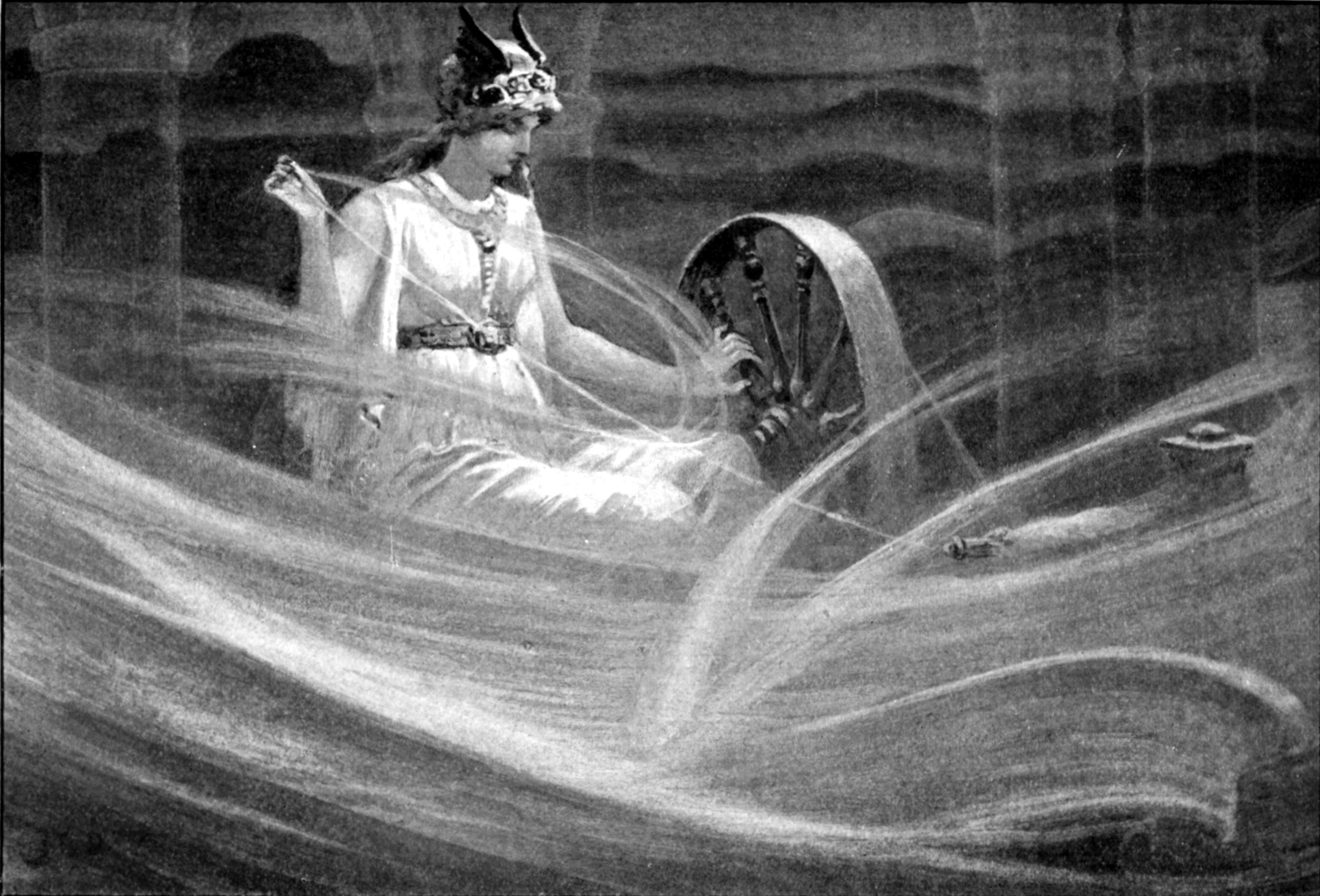 |
| Frigg Spinning the Clouds by John Charles Dollman (1909) |
There are other instances in which the use of seidr is paired with the element of wind. In the Edda, Snorri states that "the mind should be paraphrased by calling it the ogress' wind." (which may be a more or less flattering depiction of the energy of the mortal mind!) All of this made so much sense to my own philosophy of the air element as the force of consciousness, the mind, and the essence of sorcery. The author also discussed similarities for the Old Norse words for "ond" (spirit) and "anda" (breath). This idea of a connection between spirit and breath made me think of the necessity of magical songs or chants described in sources like Erik the Red regarding the performance of oracular seidr by traveling women (volva, or witches). It makes sense that the voice would be an essential part of these acts of magic and prophecy when one understands the connection between the wind (breath) and the mind or spirit, aka the catalyst of magical art in Norse culture.
Another important connection with the wind element comes in the form of the distaff, a practical tool used by women to spinning yard. There is much evidence, both in literature and the archeological record, that the distaff was sort of a dual purpose practical/magical tool associated with both women and sorcery. These beliefs translated within the region to other groups, most notably the Saami people of Northern Norway. In one tale, a skipper's wife uses her distaff to spin the sea wind, effectively pulling the man back home to her. Three wind knots are described as the form of the human soul in "The Son of the Sun," one of the Saami people's primary mythological poems. The Saami also believed that a person was capable of "making the kind of wind that was blowing when they were born." Other tales depict the various use of knots to summon wind or spirits to do the person's bidding.
These connections between the idea of wind, spinning, and spiritual power and energy were very important to me as they came together so well with my own ideas and beliefs about magic and the elements. How fitting that Freyja was the mistress of seidr! The knowledge that she wore a falcon cloak to fly between the worlds did not escape me either in its connection to the wind element and of self projection out of one's body as a magical technique. This was cemented for me much later when asked Freyja to show me how she performed seidr in trance (after much much begging). She showed me the movements and how she used the wind to create a swirling cyclone to pull in that which she desired.
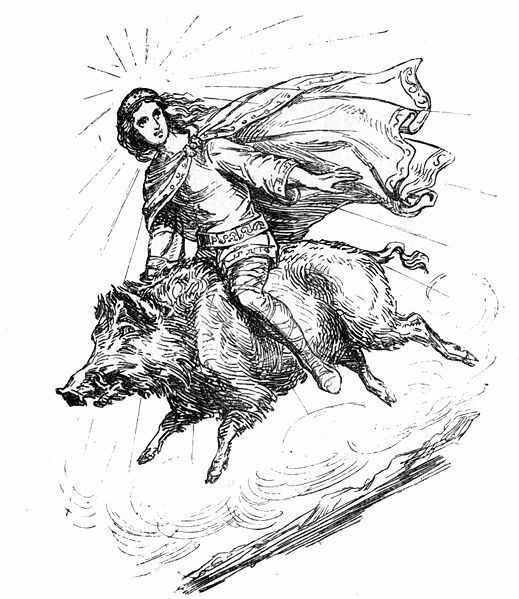
This "pulling in" of energy also made sense to me in relation to the idea that seidr was an ergi or unmanly art. Being a receptive vehicle rather than a penetrative one violated their traditional taboos about sexuality and the role of gender. I dont think it is an accident that male sorcerers in the sagas are portrayed as malevolent figures, given that the outward, destructive movement of energy using seidr would have been more fitting given their ideas of manliness in general, though the act itself would have been considered ergi it may have been viewed as more acceptable for men to use such powers in an ultimately penetrative way.
I hope this post has been atleast coherent, my purpose was to illustrate how my tradition is the result of a sort of evolution of ideas, or perhaps a personally valid epiphany. More so it is intended to illustrate how one can develop their own traditions, not by invention but rather by discovery. I encourage anyone curious about seidr to read the article mentioned, as it is in my opinion one of the best explanations of seidr and best documented by historical research. I would also like to add that much of the historical information in this post can be found within the paper itself, because such work deserves credit! At the time I read it, the paper transformed my practice and beliefs, and cemented my own connection with the Vanir in a concrete way. Please let me know if you have any comments or questions on this post!
In Frith,
Cena


Comments
Post a Comment