Pop Culture Paganism: Myth and Fiction are =/=, but does it matter? Yes and No.
I want this post to be very measured, and to make certain that my own thoughts about the validity or value of Pop Culture Paganism are not used as an assault or attack on those who practice it. So I start this post by saying that the opinions and thoughts contained here will reflect my own thoughts on the topic, and are in no way intended to be taken as a form of judgment against anyone and their own beliefs and practices.
It is entirely possible to hold your own beliefs on what has value while acknowledging that what has no value to you may be the bread and butter for someone else. My views on Pop Culture Paganism are similar to my views on mainstream Christianity in this way, yet one cannot help but see the vast distance between the values that they transmit within our culture.
I feel that every person in entitled by human rights to hold their own beliefs about the divine and the spiritual, and practice them accordingly, so long as such beliefs and practices are causing no harm to others or impeding the rights of others to do the same. This can be a slippery slope when it comes to mainstream Christian practice, as these beliefs can and have led to the justification of many human rights abuses such as the denial of marriage equality or abortion rights for women, or the continued inequality faced by people of color, the disabled, LBGT individuals,women, and the poor.
I have seen none of these abuses in regards to the pop culture pagan community, and in fact have seen much more support from them in regards to issues of social justice. So in this way I feel on a personal level that the pop culture pagan movement is a beneficial place in terms of their treatment of human rights and the values that they possess in the more general social sense. I see a great deal of humanist compassion in the Pop Culture Pagan movement that most definitely speaks positively to me.
In terms of belief, I think the main problem I have with Pop Culture Paganism is the belief that something created as admitted fiction is being viewed as a real living entity of the divine. I just can't get past it. The main argument I hear in regards to the validity of pop culture paganism is the idea that all myths were stories created by a single human being at some point in history. Why, some ask, can't the same experience occur here in the postmodern age?
To me that question is a vast oversimplification of the creation and evolution of the mythic oral traditions from which many pantheons of gods have sprung. The claim that the gods and their myths sprung whole from a singular human mind is quite a romantic notion, yet like most romantic notions it falls flat in the face of reality. It is also a projection of the modern mind's experience of story (the linear, textual progression from start to finish) onto the complex circular, holistic rhythms and evolution of story as they are experienced in ancient, oral cultures.
In short,my qualm with Pop Culture Paganism has little to do with the belief aspect and more about the way that some use it to devalue ancient mythic traditions by asserting that a centuries old myth developed and evolved over hundreds and in some cases thousands of years is somehow equal in value to a work of fiction, film, or media created by a single modern mind. You simply cannot compare the shared gnosis of millions of people throughout ages to the imagination of one creative mind working admitted fiction and a few loyal followers who happen to believe that the work may speak on a deeper truth. This is true even without the fact of the wealth of other types of cultural information that many myths can translate, such as knowledge of historical events, the growth of a society, the changes in language and its growth, etc. To compare modern fiction to cultural myths spanning centuries is simply a false analogy that IMO devalues oral cultures and oversimplifies their world in a very Classical, Eurocentric manner. Ancient myths represent entire cultures, their shared history, and even their persecutions. The same depth of meaning cannot and should not be attached to a modern work of fiction. It has its own meaning of course, but that meaning is unequal to that of myths passed down through the ages.
Are pop culture pagans simply witnessing the birth of modern mythic traditions? Are they the disciples of new myths that will grow in truth and power in the centuries to come? It is entirely possible, though in my opinion unlikely given that these works are admitted by their creators as fictional works in the historical record rather than transmitted as truth in an oral culture. Even so, I support pop culture paganism as a new turn in spiritual expression and have no issues supporting those who feel it is the right path for them and find value in it. No one can predict how religion and spirituality will evolve in the future, and I think the spirit of exploration and questioning accepted truths is always the wisest path to take. I support Pop Culture Pagans just as I support any tradition that thinks out side of the box and explores new avenues of divinity.
The only thing I cannot support is the equalizing of modern fiction to longstanding well developed cultural mythos. They simply do not at the current time hold the same value, regardless of how one equates them. Not because one is somehow better than the other, but rather because they have little in common outside of the fact that they are stories. They do not hold the same functions or the same types of information. They do not represent the same amount of time and knowing, nor the same amount of influences from mass amounts of human consciousness. They are not comparable, and to do so is a false analogy and a flaw in logical, rational thought.
Please be aware that my opinion is my own, and does not confer any sort of judgment on those who practice Pop Culture Paganism. My disagreement on the argument given above simply stems from a place of concern and perhaps a bit of OCD from someone who places an intense value on the artistic expression and culture in general. Modern works of fiction may at some point transition into myth and cultural truth, but until history makes that a certainty let's leave both alone and stop comparing them. Let both ancient myth and modern creative works stand on their own. Because neither phenomena begs justification, and both have value in their own right, albeit the differences which make them incomparable.
In Frith
Cena
For more study on how print changed storytelling and culture, David Finkelstein's "An Introduction to Book History" is a great start. You can find it on Amazon at this link Amazon Link: An Intro to Book History
For more about the differences between oral traditions and western literacy and the way comparison denigrates oral culture, See Nathalie Piquemal's "From Native North American Oral Traditions
to Western Literacy: Storytelling in Education," which can be found in the Alberta Journal of Educational Research, Volume 49, p. 113
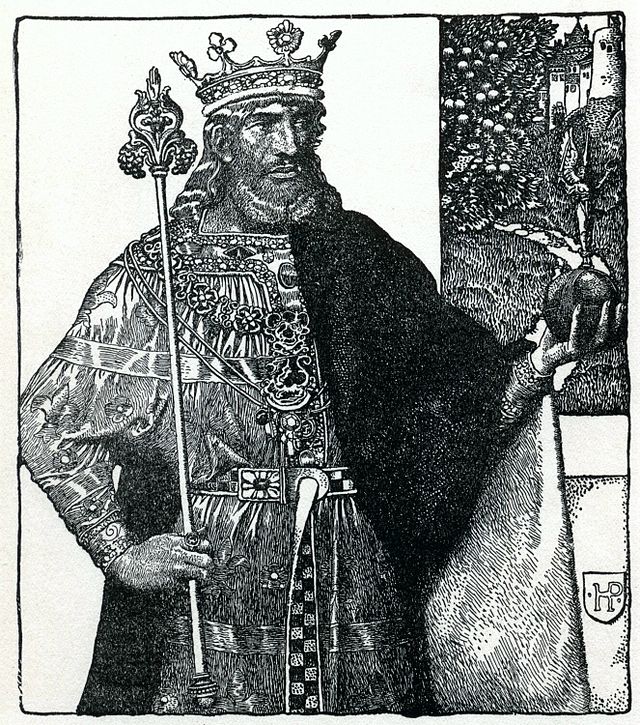 |
| King Arthur of Britain by Howard Pyle 1903 (Public Domain) Man, Myth, or Fictional Character? We can quibble... |
I feel that every person in entitled by human rights to hold their own beliefs about the divine and the spiritual, and practice them accordingly, so long as such beliefs and practices are causing no harm to others or impeding the rights of others to do the same. This can be a slippery slope when it comes to mainstream Christian practice, as these beliefs can and have led to the justification of many human rights abuses such as the denial of marriage equality or abortion rights for women, or the continued inequality faced by people of color, the disabled, LBGT individuals,women, and the poor.
I have seen none of these abuses in regards to the pop culture pagan community, and in fact have seen much more support from them in regards to issues of social justice. So in this way I feel on a personal level that the pop culture pagan movement is a beneficial place in terms of their treatment of human rights and the values that they possess in the more general social sense. I see a great deal of humanist compassion in the Pop Culture Pagan movement that most definitely speaks positively to me.
In terms of belief, I think the main problem I have with Pop Culture Paganism is the belief that something created as admitted fiction is being viewed as a real living entity of the divine. I just can't get past it. The main argument I hear in regards to the validity of pop culture paganism is the idea that all myths were stories created by a single human being at some point in history. Why, some ask, can't the same experience occur here in the postmodern age?
To me that question is a vast oversimplification of the creation and evolution of the mythic oral traditions from which many pantheons of gods have sprung. The claim that the gods and their myths sprung whole from a singular human mind is quite a romantic notion, yet like most romantic notions it falls flat in the face of reality. It is also a projection of the modern mind's experience of story (the linear, textual progression from start to finish) onto the complex circular, holistic rhythms and evolution of story as they are experienced in ancient, oral cultures.
In short,my qualm with Pop Culture Paganism has little to do with the belief aspect and more about the way that some use it to devalue ancient mythic traditions by asserting that a centuries old myth developed and evolved over hundreds and in some cases thousands of years is somehow equal in value to a work of fiction, film, or media created by a single modern mind. You simply cannot compare the shared gnosis of millions of people throughout ages to the imagination of one creative mind working admitted fiction and a few loyal followers who happen to believe that the work may speak on a deeper truth. This is true even without the fact of the wealth of other types of cultural information that many myths can translate, such as knowledge of historical events, the growth of a society, the changes in language and its growth, etc. To compare modern fiction to cultural myths spanning centuries is simply a false analogy that IMO devalues oral cultures and oversimplifies their world in a very Classical, Eurocentric manner. Ancient myths represent entire cultures, their shared history, and even their persecutions. The same depth of meaning cannot and should not be attached to a modern work of fiction. It has its own meaning of course, but that meaning is unequal to that of myths passed down through the ages.
Are pop culture pagans simply witnessing the birth of modern mythic traditions? Are they the disciples of new myths that will grow in truth and power in the centuries to come? It is entirely possible, though in my opinion unlikely given that these works are admitted by their creators as fictional works in the historical record rather than transmitted as truth in an oral culture. Even so, I support pop culture paganism as a new turn in spiritual expression and have no issues supporting those who feel it is the right path for them and find value in it. No one can predict how religion and spirituality will evolve in the future, and I think the spirit of exploration and questioning accepted truths is always the wisest path to take. I support Pop Culture Pagans just as I support any tradition that thinks out side of the box and explores new avenues of divinity.
The only thing I cannot support is the equalizing of modern fiction to longstanding well developed cultural mythos. They simply do not at the current time hold the same value, regardless of how one equates them. Not because one is somehow better than the other, but rather because they have little in common outside of the fact that they are stories. They do not hold the same functions or the same types of information. They do not represent the same amount of time and knowing, nor the same amount of influences from mass amounts of human consciousness. They are not comparable, and to do so is a false analogy and a flaw in logical, rational thought.
Please be aware that my opinion is my own, and does not confer any sort of judgment on those who practice Pop Culture Paganism. My disagreement on the argument given above simply stems from a place of concern and perhaps a bit of OCD from someone who places an intense value on the artistic expression and culture in general. Modern works of fiction may at some point transition into myth and cultural truth, but until history makes that a certainty let's leave both alone and stop comparing them. Let both ancient myth and modern creative works stand on their own. Because neither phenomena begs justification, and both have value in their own right, albeit the differences which make them incomparable.
In Frith
Cena
For more study on how print changed storytelling and culture, David Finkelstein's "An Introduction to Book History" is a great start. You can find it on Amazon at this link Amazon Link: An Intro to Book History
For more about the differences between oral traditions and western literacy and the way comparison denigrates oral culture, See Nathalie Piquemal's "From Native North American Oral Traditions
to Western Literacy: Storytelling in Education," which can be found in the Alberta Journal of Educational Research, Volume 49, p. 113


Comments
Post a Comment