Freyja's Cats Part 2: Seidhr, Sorcery, and Pagan Power
Hello again! I'm back with another post continuing the summary of Freyja's Cats, a thesis by Brenda Prehal exploring the image and myths of cats in Norse culture. In the first post I summarized some information from the paper which gave some examples of how cats were portrayed in Norse literature and the material record. This post will focus mainly on the cat in relation to the practice of Seidhr, the goddess Freyja, and the idea that the cat may have been somewhat symbolic of elite pagan power in Scandinavia. From now on my own thoughts and interjections will appear in bold, as opposed to paraphrasing of the original paper in plain text.
The abundance of cat imagery and folklore in non-Eddic literary sources and the material record is contrasted by the near absence of cats within the Eddas. The author questions the reasons for this within a short discussion. The main idea here is that the cat (along with various other female goddesses such as Freyja and Frigg) imagery was downplayed or removed by the authors of the Eddas as it conflicted with the rising Christian ideology which had begun to spread at the time the Eddas were composed.
This possibility is often overlooked or downplayed in modern heathenry as many seem to believe that such suggestions play into some sort of anti-male feminist agenda. However there may be another explanation as to why cats were diminished in the Eddas, and this is that the cat could have been a symbol not of feminine power, but rather of elite pagan power in general. The image of the cat is associated not only with Freyja and the volva, but also in some ways with Odin himself, and a particularly well known class of Norse warriors. The cat being heavily associated with both elites and rulers as well as the and pagan religion can be viewed as one major reason their lore is downplayed by the Christianized writers of the Eddas.
At this point the author begins to explore the image of the cat in relation to the Goddess Freyja. In Freyja we see a multi-faceted and at times dualistic divine being which some believe may be derived from much earlier traditions than the Viking age represents. In any case, the character of Freyja is often split, being a goddess of both love and war, light and darkness, sex and magic. Her animal companions often reflect this, particularly that of the pig or boar. One of Freyja's alternate names is means "sow" and her connection to the cat is well known. Both animals are symbolic of fertility. In her alternate guise, she is accompanied by the both boars and falcons, which are associated with battle.
Another interesting point the author makes is that though the name of Freyja's cats which pull her chariot are not named, they are denoted as male cats specifically. The author believes this may indicate a sort of symbolic representation of hieros gamos (Sacred Marriage) of the masculine and feminine sexuality. This is supported by the gold foils which depict Freyr/Freyja or Freyr/Gerd embracing, as well as the abundance of cat imagery found within the Oseberg ship burial. In each of these examples, we see the cat connected deeply to the pagan rulers of the elite class.
Cats, Freyja, and Seidhr
The author moves now to a discussion of cats in a religious context within Norse culture, particularly to the practice of magic or sorcery called seidhr. This practice can be called shamanic in the modern context, and anthropological studies suggest that the practice of seidhr was either derived from or influenced by the Saami, an indigenous Northern European people who live in Arctic areas in the far North regions of Scandinavia.
Instances of seidhr performed seem to indicate regenerative type of magic, in some cases it was used to resurrect the dead. It was referred to as being spun or woven, a concept which has much in common with the folkloric practice of magic by the Saami. It is also made clear within the lore that Seidhr was a form of magic associated almost exclusively with women, with the exception of Odin.
The idea of spinning or weaving as a form of magic goes as far back into Norse belief as the three Norns, female divinities who "weave" the strands of wyrd to create and control the fate of man and time itself. Also worth noting is that literary sources state that the women of the house always presided over the elf-blots, a point which strengthens the connection of Seidhr to the feminine and also illustrates the figure of the female as a magical leader within the culture. It is easy to understand why this practice was diminished within Christianized literature such as the Eddas.
Connections between Saami Shamanism and Seidhr
 |
| Animal-head post 174 from the Oseberg ship-burial |
The abundance of cat imagery and folklore in non-Eddic literary sources and the material record is contrasted by the near absence of cats within the Eddas. The author questions the reasons for this within a short discussion. The main idea here is that the cat (along with various other female goddesses such as Freyja and Frigg) imagery was downplayed or removed by the authors of the Eddas as it conflicted with the rising Christian ideology which had begun to spread at the time the Eddas were composed.
This possibility is often overlooked or downplayed in modern heathenry as many seem to believe that such suggestions play into some sort of anti-male feminist agenda. However there may be another explanation as to why cats were diminished in the Eddas, and this is that the cat could have been a symbol not of feminine power, but rather of elite pagan power in general. The image of the cat is associated not only with Freyja and the volva, but also in some ways with Odin himself, and a particularly well known class of Norse warriors. The cat being heavily associated with both elites and rulers as well as the and pagan religion can be viewed as one major reason their lore is downplayed by the Christianized writers of the Eddas.
At this point the author begins to explore the image of the cat in relation to the Goddess Freyja. In Freyja we see a multi-faceted and at times dualistic divine being which some believe may be derived from much earlier traditions than the Viking age represents. In any case, the character of Freyja is often split, being a goddess of both love and war, light and darkness, sex and magic. Her animal companions often reflect this, particularly that of the pig or boar. One of Freyja's alternate names is means "sow" and her connection to the cat is well known. Both animals are symbolic of fertility. In her alternate guise, she is accompanied by the both boars and falcons, which are associated with battle.
Another interesting point the author makes is that though the name of Freyja's cats which pull her chariot are not named, they are denoted as male cats specifically. The author believes this may indicate a sort of symbolic representation of hieros gamos (Sacred Marriage) of the masculine and feminine sexuality. This is supported by the gold foils which depict Freyr/Freyja or Freyr/Gerd embracing, as well as the abundance of cat imagery found within the Oseberg ship burial. In each of these examples, we see the cat connected deeply to the pagan rulers of the elite class.
Cats, Freyja, and Seidhr
 | ||
| Gilt-bronze mount (possible weather-vane) from Rangsby, | Saltvik, Aland, Finland; National Museum, Helsinki |
The author moves now to a discussion of cats in a religious context within Norse culture, particularly to the practice of magic or sorcery called seidhr. This practice can be called shamanic in the modern context, and anthropological studies suggest that the practice of seidhr was either derived from or influenced by the Saami, an indigenous Northern European people who live in Arctic areas in the far North regions of Scandinavia.
Instances of seidhr performed seem to indicate regenerative type of magic, in some cases it was used to resurrect the dead. It was referred to as being spun or woven, a concept which has much in common with the folkloric practice of magic by the Saami. It is also made clear within the lore that Seidhr was a form of magic associated almost exclusively with women, with the exception of Odin.
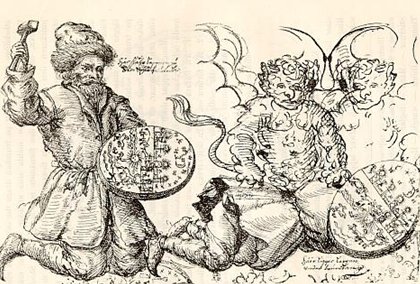 |
| A Christian drawing illustrating a Sami Shaman using the traditional drum to consult with "demons". Like the Native Americans, the Sami faced gross persecution at the hands of the Christians. |
The idea of spinning or weaving as a form of magic goes as far back into Norse belief as the three Norns, female divinities who "weave" the strands of wyrd to create and control the fate of man and time itself. Also worth noting is that literary sources state that the women of the house always presided over the elf-blots, a point which strengthens the connection of Seidhr to the feminine and also illustrates the figure of the female as a magical leader within the culture. It is easy to understand why this practice was diminished within Christianized literature such as the Eddas.
Connections between Saami Shamanism and Seidhr
- In one of Egill's lausavisur, the name Simul, or "fainter" is used to denote Freyja. This is largely attributed to a form of shamanic trance or shapeshifting used to perform magic
- Spinning or weaving as a form of magic or spellwork
- bodies lay as if dead while the spirit/fylgia leaves the practitioner to travel in search of information or perform magic
- Animals are used as symbolic guides during travels through spirit realms
- The Saami use the word "Sueje", which means "shadow" to reference the process of trancework. This word has a phonetic link to the Norse word "fylgia."
Seidhr is heavily associated with cats both through Freyja as well later descriptions of traveling volva (seidhr practitioners) who wore particular garments made of catskin.
It is duly noted that much of these same similarities can apply to instances of magic and trance depicting Odin as well. The sacrifice of the body on the World tree, the presence of animals presiding over the tree itself, one being unsurprisingly, a cat.
Berserkers
The famous berserkers were an elite cult of warriors who used magical means to transform themselves into monstrous fighters and in some instances even said to "become" bears which battle. In more believable accounts, the berserkers were warriors who wore only bearskins in battle and became battle frenzied and animalistic by the use of magical trance.
There are two points of interest when it comes to the Berserkers and their magic. One is that one of the common kennings for bear is "gib-cat." This denotes a male cat, much like Freyja's steeds. Another noteworthy connection is the fact that berserkers wore specific garments (bearskins) in order to "become" bears. The volva wears specific garments (catskin) to perform seidhr. And Freyja herself wears a cloak (falcon) in order to fly into other realms. In the Lay of Hyndla, Freyja transforms her lover into a boar which she "rides" into the Underworld, which suggests that seidhr could also possibly be used to transform not only oneself but others as well.
All these evidences make a strong argument for the practice of elite pagan forms of magic which would have been viewed as dangerous and likely stifled by Christian influenced writers. This may explain why cats were so often omitted within the myths of Eddaic poetry, yet in abundance among alternate literary forms and material finds.
I think this is a good place to stop for today. Hope you all enjoy the posts, and there is more to come!
In Frith
Cena
References:
Prehal, B. (2011). Freyja’s Cats: Perspectives on Recent Viking Age Finds in !egjandadalur North Iceland.
New York, NY: Hunter College of the City University of New York.
Sami Drums: Then and Now (University of Texas) University of Texas Music Pages


Comments
Post a Comment