The Mysterious Nehalennia
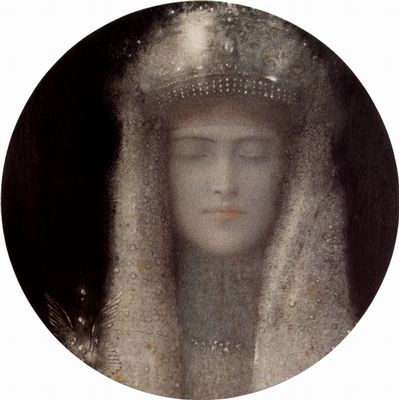 |
| Modern interpretation of the Goddess Nehalennia |
So what do we know about Nehalennia? In the 1600s, erosion of the sands near the Dutch town of Domburg revealed a previously unknown temple dedicated to the goddess, containing 28 inscriptions to her. Further archeological finds in Cologne, Germany and the town of Colijnsplaat in the Netherlands also attested to her existence as a divine figure. Many of these finds contain votive altars specifically created in honor of her, and are comparable to many other such votive altars in Northern Europe which are commonly devoted to the worship of the Matrones, Disir, or "Mothers," the ancestral mothers and mother goddesses of the heathen folk. To date over 160 such votive altars have been discovered with inscriptions and images of Nehalennia, most of them in the Zeeland area of the Netherlands.
We know from the inscriptions left on many of these altars that they were placed as acts of devotion, in thanks for safe passage across the waters, which gives us our first bit of knowledge about Nehalennia, in that she was a marine goddess. Here is a sample inscription from one of her altars.
To the goddess Nehalennia,on account of goods duly kept safe,Marcus Secundinius Silvanus,trader in pottery with Britain,fulfilled his vow willingly and deservedly.
One of the interesting things about Nehalennian altars is that though they reveal her connections with the sea, it is unclear whether she was seen as a protective force or rather a malevolent one. She is commonly depicted with a ship's prow beneath her foot. Is it placed so for aesthetic purpose, or is she literally trampling the ships at sea? Were the altars created as an act of gratitude, or rather as a means of fulfilling a vow upon which the sailors lives depended when her fury was unleashed upon them? We can only speculate upon the current evidence.
 |
| Altar of Nehalennia (Rijksmuseum van oudheden, Leiden) |
The nature of these altars also makes it hard to determine exactly who was worshiping Nehalennia. At the time there was no known fully developed form of Germanic or Celtic languages, and the inscriptions on these altars were in Latin. Due to trade, Latin was known in some Germanic and Celtic countries, so it is difficult to tell if Nehalennia was an original Germanic or Celtic goddess, or if she was "imported" so to speak from Roman merchants and traders who traveled northward. Many of her altars were erected by merchants and traders, but it is difficult to determine the native country from which Nehalennia originated in light of the evidence.
Outside of the marine references, Nehalennia is often depicted with a basket of apples and or loaves of bread, of which the loaves were specifically connected to Vanic divinity in the mind of Ellis Davidson. Such loaves were not uncommon among other matron altar figures, and Davidson took this as an indication of heathen origination, or at the least a blending of Latin and Germanic/Celtic divinities. The use of loaves as an offering to maternal goddesses and other divine figures is one that is common in Germanic (specifically Vanic), Anglo-Saxon, and Irish pagan traditions of pre-Christian period. Some have also speculated that the basket of apples may connect her to the Germanic Goddess Idunna.
The last of Nehalennia's common association is with the canine. Many of her altars also depict a dog companion at her side, looking much like a greyhound. We can only speculate on the meaning of this due to a lack of sources on canines in Germanic culture and pagan tradition. However it is interesting to note that the dog has been seen as a symbol of loyalty, protection, and companionship across most cultures since they became domesticated.
 |
| Bronze statuette (Römisch-Germanisches Museum, Cologne) |
Nehalennia is hard to pin down, and even harder to understand in terms of the sheer lack of evidence we have about her. Yet many modern Vanatru have accepted her into their pantheons, as well as other Germanic pagans. It may take much time and work to discover her enigmatic nature, yet in my eyes she is a valuable addition to the whole of modern Germanic paganism in all its forms.
Modern day practitioners could easily incorporate Nehalennia into both Loafmass ceremonies and celebrations as well as other agricultural holidays such as The Charming of the Plough, due to her associations with bread and grain.
In Frith
Cena


Comments
Post a Comment